 800 326 9054
Plans by Union Pacific and Norfolk Southern to become the first coast-to-coast railroad company are drawing interest from some shippers excited by the prospect of fewer delays, but concern from others about competition.
The companies have submitted an initial 6,700 page proposal to the Surface Transportation Board that includes statements of support from some farmers and agricultural companies. However, the document has drawn criticism from other major railroads and some shipper groups, who argue it leaves out critical information about the merger’s potential competition impacts and the flow of goods throughout the U.S.
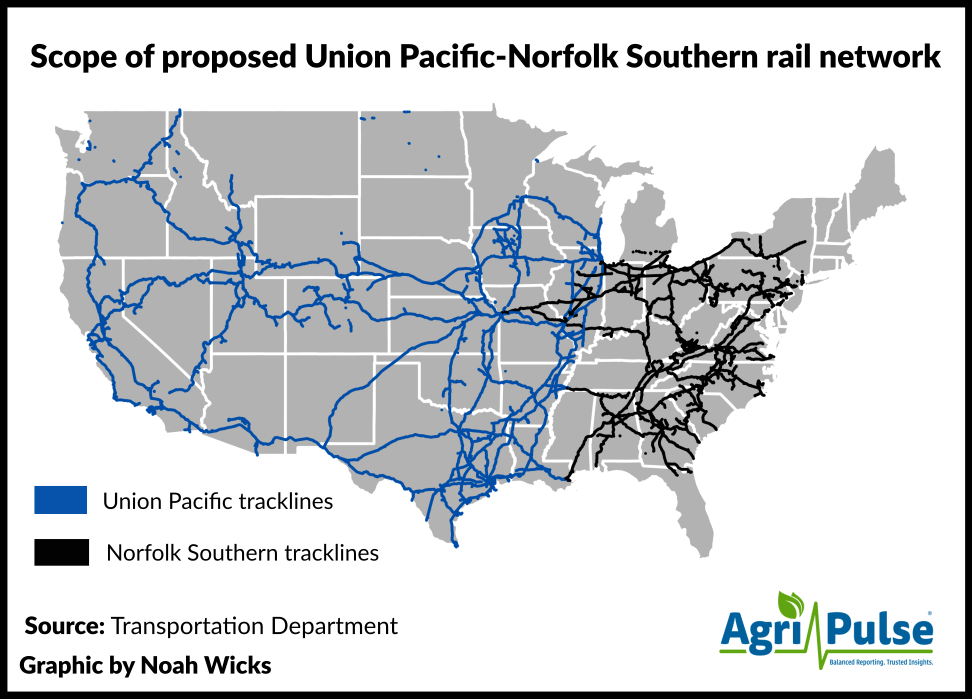
When the application was first sent to the STB last month, Union Pacific CEO Jim Vena said the merger would provide customers with “stronger, more connected freight rail.” If the merger goes through, the new railroad’s tracks will span approximately 50,000 miles and connect around 100 U.S. ports on the East, West and Gulf Coasts.
The filing argues the merger will enhance competition by competing with long-haul trucking, which it says “dominates the transportation marketplace.” It notes that the proposed “end-to-end” railroad line would “not eliminate parallel routes or diminish competitive alternatives.”
It also says a transcontinental railroad network “will give the ag industry more options.”
“It would enable grain, wheat, and feed products to move more efficiently from the Midwest to mills and feed markets in the Southeast and East,” the filing says. “It would open up new lanes for ethanol to reach the Gulf, West Coast, and East Coast, and for renewable diesel and other clean-fuel projects to grow with confidence.”
The companies have also proposed a new “Committed Gateway Pricing” model. The filing included a statement from Katherine Novak, Union Pacific’s general director of interline operations, that says the new framework would create a system for calculating revenue requirements when serving customers shipping to or from facilities served by BNSF or CSX, two other major rail networks.
More specifically, the framework would “allow BNSF and CSX to directly market transcontinental service, offering one-stop shopping to customers shipping traffic between facilities they solely serve, and facilities served solely by UP/NS when they interchange traffic with UP/NS in Chicago, St. Louis, Memphis, and New Orleans, regardless of whether they are the originating or terminating carrier.”
“Committed Gateway Pricing is purely additive: It will give eligible customers — that is, customers shipping eligible interline movements — an additional rate and service option without eliminating any existing rate or service option available to customers,” Novak wrote.
If the STB were to accept the application, it would kick off a 45-day public comment period and a year-long evidentiary proceeding process. Once that closes, the board will have 90 days to make a decision, according to an explanation of the merger review process on its website.
Supporters expect efficiency gains as critics warn of fewer options
Richard Gupton, senior vice president for public policy and counsel for the Agricultural Retailers Association, told Agri-Pulse that if this merger is approved, it could lead to BNSF and CSX — the two other major railroads — to pursue a merger of their own, which would present U.S. shippers with “two major railroads from coast-to-coast as options.”
If the rail industry were to see such high concentration, Gupton warned that rail companies may decide in the future to cut back their presence in rural areas, which could force some rural businesses to turn to trucking — a more expensive option.
In written testimony, Eric Heismeyer, President and CEO of Landus Cooperative, said he believed the proposed merger will improve service reliability by offering more direct routes and greater flexibility, reduce transit times by eliminating interchanges, and expand Landus’s geographic reach.
Steve Schult, the vice president of global supply chain for the Blue Diamond farm cooperative, wrote that it would provide the almond company with greater access to ports for shipping its products outside of the United States. James Burgum, CEO of the Arthur Cos., a North Dakota agronomy business, said in a comment that “with the right oversight,” the merger “represents a meaningful step forward for the long-term health of U.S. agriculture and supply chains.
“Farmers don’t have time or margin for delays. The sooner this merger is approved, the sooner we can all start seeing the benefits—fewer bottlenecks, better access, and lower costs across the supply chain,” he wrote.
For the U.S. chemical industry, the merger will be particularly consequential, said Scott Jensen, the director of issue communications for the American Chemistry Council. If it goes through Union Pacific and Norfolk Southern will have control over most of the chemical shipments in the U.S., which means chemical companies — already facing limited shipping options — could have even fewer, he said.
“Most of the majority of chemical facilities are served by a single railroad anyway,” Jeffrey Sloan, ACC’s senior director of regulatory and scientific affairs, told Agri-Pulse in an interview. “So, they’re already lacking in competition. What this merger is going to do is extend the distance where many facilities are going to be captive to a single railroad.”
In their application, UP and NS argued the merger would give chemical producers “greater reach with fewer handoffs, faster transit times, and more dependable delivery.” Their analysis projected over 55 thousand carloads of chemicals and related products will be converted from truck to single-line rail service.
Shippers, rivals challenge sufficiency of merger application
The STB accepted initial comments on the application through Dec. 29 but asked those submitting to focus specifically on whether the application was complete and not missing any information.
In a comment, National Grain and Feed Association attorney Thomas Wilcox took issue with the sufficiency of the railroads’ proposals to enhance competition, saying their “spare discussion” of potential competitive harms is “deficient under both the letter and spirit” of existing STB rules. He argued that protecting 2-to-1 shipper facilities and preserving existing gateways “falls into the category of preserving competition, not enhancing it.”
Wilcox also said Union Pacific and Norfolk Southern’s proposed service assurance plan fails to establish a process to compensate shippers for service failures and lacks information on back-up or contingency plans that involve other rail carriers.
In response, lawyers for the two railroads argued NGFA’s assertions were incorrect and said the organization’s critiques were based on the merits, not the completeness of the application. It said board rules “do not require applicants to posit and discard hypothetical access regimes across every potential geography merely to demonstrate that alternatives were considered.”
“Rather, the board’s decision and rules contemplate that applicants retain discretion to propose a transaction specific approach to satisfy the board’s expectation of a special offering to enhance competition,” they wrote.
They also claimed that STB’s rules do not require applicants to include any arbitration mechanism in its plan, but instead “encourage applicants to consider such approaches as one possible means of addressing service issues.” Ultimately, they said NGFA’s disagreement “with the contours of that proposal involves substantive questions that belong in the merits phase” of the merger proceeding.
BNSF counsel Daniel Donovan argued in a comment that in their analysis, UP and NS “all but ignore the merger’s effects on geographic and product competition, instead repeating that this is an ‘end-to-end’ merger.” He noted that the application “does not try to model any shifts in traffic flows” and he said the railroads’ discussion of downstream industry structure “amounts to little more than a shrug and suggestion to ask BNSF and CSX.”
Meanwhile, lawyers for CSX, another major railroad, raised concerns about the future of the Terminal Railroad Association of St. Louis (TRRA), one of two terminal railroads operating in the St. Louis gateway. The other is already wholly owned by UP, the comment said.
“[T]he transaction would give UP complete control of the St. Louis gateway on which CSXT and all other Class I railroads rely to compete, including both Mississippi River bridges, the two rail belts around East St. Louis, multiple joint use yards, and extensive track CSXT and other carriers rely on to connect,” they said.
They continued: “There is ‘clear’ potential for anticompetitive effects from UP’s control of these facilities.”
In response to CSX’s concerns about acquiring TRRA, the UP-NS lawyers said company leaders have “committed to divesting NS’s ownership interest in the entity and redistributing it equally to other TRRA owners. They also said TRRA’s operating agreement “specifically and unequivocally prohibits” the terminal from discriminating in favor of any particular company when it comes to transfer or handling of cars.
*Sourced from Agri-Pulse.